Whether big or small, you shouldn’t stop with just an idea. Build it until it uncovers the dream you’ve had all along. You’ll be surprised when the time pass and this small idea of yours gets even bigger than you imagined.
Because you’re not the only one who has that idea right now. Believe me, your fresh idea has probably failed so many times already into the hands of another. And time will reveal that those who didn’t quit, will succeed with your idea if you don’t get to it first.
And don’t ever think that there’s no place in this world for your unpopular business proposal. It may be unreal to some, but HEY! there is more than 7 billion people in this world. You cannot not have a market for whatever that is. Don’t quit!
The most important thing is you have to BELIEVE IN YOURSELF! If no one you know believes in you, you can’t let your own self down. You’re the only one left to believe in you, so don’t let yourself down. Pick yourself up every time you fall down.
It doesn’t matter how many times you fail. What matters is how many times you try to succeed. There’s a lesson in every failure. You pick it up and eat it. No one says it better than Jack Ma. I concur with a lot of his wise words.
No matter what one does, regardless of FAILURE or SUCCESS, the experience is a form of success in itself
Jack Ma
My father once told me, you may try and fail, but never fail to try. Because if you don’t even try, then you’ve already failed. Success comes only to those who do not quit. So try, and don’t quit.
There are a lot of successful people in the world, but recently, Jack Ma has really gotten into me. His wisdom will really shape you.
You don’t define success once you hit the millions or the billions. Success in business is defined when people start embracing what you believed in. Just like in sales, you don’t get success by the amount of items you sold, but by the trust you gained from people who bought them.
When you put up a business, you’re not selling your product or your business. You’re selling your trustworthiness to people and that’s what people really buy. They buy your product or subscribe to your service because they trust your business. And your business is you. This is also why business name is important. And you’ll notice how people buy really expensive stuff from well-known brands. This is because they trust the brand. And the brand is YOU!
When doing Sales, the first people who will trust you will be Strangers, Friends will be shielding against you, fair-weather friends will distance from you. Family will look down upon you.
Jack Ma
Let’s take it from the person who literally went through everything to get to where he is now. I admire this individual. He has so much will to achieve his aspirations in life. And I connect with his ideals, not because I’m as grand as he already is, but because I’ve experienced most of it just the same.
So here are some reasons why you shouldn’t consider telling friends and family about your new business ideas.
They don’t care about the conception of your idea. To them it’s just an idea until it hits big. Even if you’ve already started, they’ll remain skeptical until you show them what to them is “real numbers” as if they are “real investors”. Your small profits won’t mean anything to them even if it means so much to you. This is a really big downer. You don’t want to get that when you’re starting up and you know you dream big. They’ll just unconsciously or intentionally crush your idea down with your dreams.
There are a couple more reasons to that. Either they don’t trust you, they want to keep themselves above you, or they’re simply not interested. But, everyone gets interested in something once it’s already big, even if it’s not their thing. So it’s a big no-no. Especially if the discouragement will come from your family. That’s an absolute downer. And you can’t help it. Because not everyone is built for what you want to achieve. But maybe you are! So go build your dream! If you need help, look for a person who’d really be interested in what you’re planning and potentially support you all the way.
Your dream could be their dream
But if they failed, they probably don’t want you to succeed either — at least not with them not being the star player of the game. Some people don’t consider you as equals. Crab mentality is a really toxic attitude. They could at least support you but they choose not to. They want it for themselves, sometimes, unconsciously. They could maybe offer help, but they want the bigger piece of the pie. When it comes to money, people either change or show their true colors.
They don’t like your idea
They think they have a better one or they think it already exists, and that what you have has nothing to beat the odds of going side by side with the big ones or has the potential to reach the top. They are basically pessimists. They’re gonna knock you down with everything that’s not good enough in your idea. “Not good enough for them”, that is.
They’re not interested at all
It’s not that they don’t like the idea. They’re just totally disinterested, so they won’t even bother to support it.
They are less structured than you are
You’ve probably thought of all this idea already and laid everything on the drawing board, visualized your end goal and have a high level outlook of the fundamentals that make it up. But your friends and family are great what-if-ers. They worry too much about the details and enter into brainstorming without framing the bigger picture first. So before you could even get their approval, they already say no because they worry so much about mitigating risks that haven’t been fully planned yet. But you’re still just on the vision, mission, and goal statement!
Unfortunately, you’re the only one who think this way. A lot of your friends or family probably think you need to have a working prototype first before you pitch to them and that it should already foolproof.
They don’t want to invest on you
Did I already say they don’t trust you? How many more permutations of reasons can you come up with on why they don’t want to invest on you? I have one, THEY DON’T TRUST YOU.
Will you invest on someone you don’t trust? Of course not! You’ll choose someone you trust. Even if it’s a stranger, you’ll dig up the person’s background, portfolio, personality and capability. You’ll want to know if the person can be trusted. It’s just like hiring an employee for a company. In short, you need to establish trust before you invest in someone or on something. It’s the same thing as trying to choose your friends as your first audience for your fresh business idea! because you already trust them.
But hey, do they trust you? Maybe in other things, but on your business proposal? Maybe or maybe not. It’s probably a 1% chance to find that guy in your circle of friends and family who will really match your aspirations and help you with it. So if you have a hundred friends, find that 1 guy and hope you’re not wrong.
Conclusion
Let’s say, not all, but most of them will be like this. So, should you or should you not tell your friends and family about your new business idea? Well, I’m not gonna answer that for you. You have to figure it out. But I’m giving you the reasons on why you shouldn’t. It doesn’t mean you can’t. There’s still a chance they’re not the type of people I mentioned in this article. But that’s up to you.
My advice is, if you plan to, don’t tell them all about it and don’t tell everyone. Choose the right people. Even if they are the kind of people I mentioned, don’t be discouraged. You still have you. You are the most important piece of your idea. Without you, it wouldn’t even be an idea. Cheers to that!
Poor People Don’t Have Less Self-Control. Poverty Forces Them to Think Short-Term — according to an article.
I’m sorry but I beg to disagree. Either I missed the context of the article or the concept is completely unacceptable. Because why do I feel like the article implies that a poor person is hopeless because of his dire condition that forces him to think short-term?
If you’re born poor, it’s not your mistake. If you die poor, it’s your mistake.
Bill Gates
If you’re still poor at 35, you deserve it.
Jack ma
These are quotes that, I believe, every poor people should have in mind
These billionaires may not have been ultimately poor, born poor, or didn’t have the privilege to get out of poverty, like any other poor person would give as an excuse, but surely, they didn’t just stood by to get to where they are now. To begin with, Jack Ma was poor. So how did he do it?
A good friend of mine once told me that if I wanted to help a person, who is having difficulties with improving himself and keeps failing at success, I have to understand if the person has a skill or a will issue.
If someone’s skill is an issue, so long as the person is willing, a skill can be learnt and be improved. But if the will isn’t there, whether the person is highly skilled or not, privileged or not, it’s a dead end unless he recovers his will.
The will is the fire, the passion, the determination to make things happen no matter what. A person will try and fail many times, but what matters is that he tries.
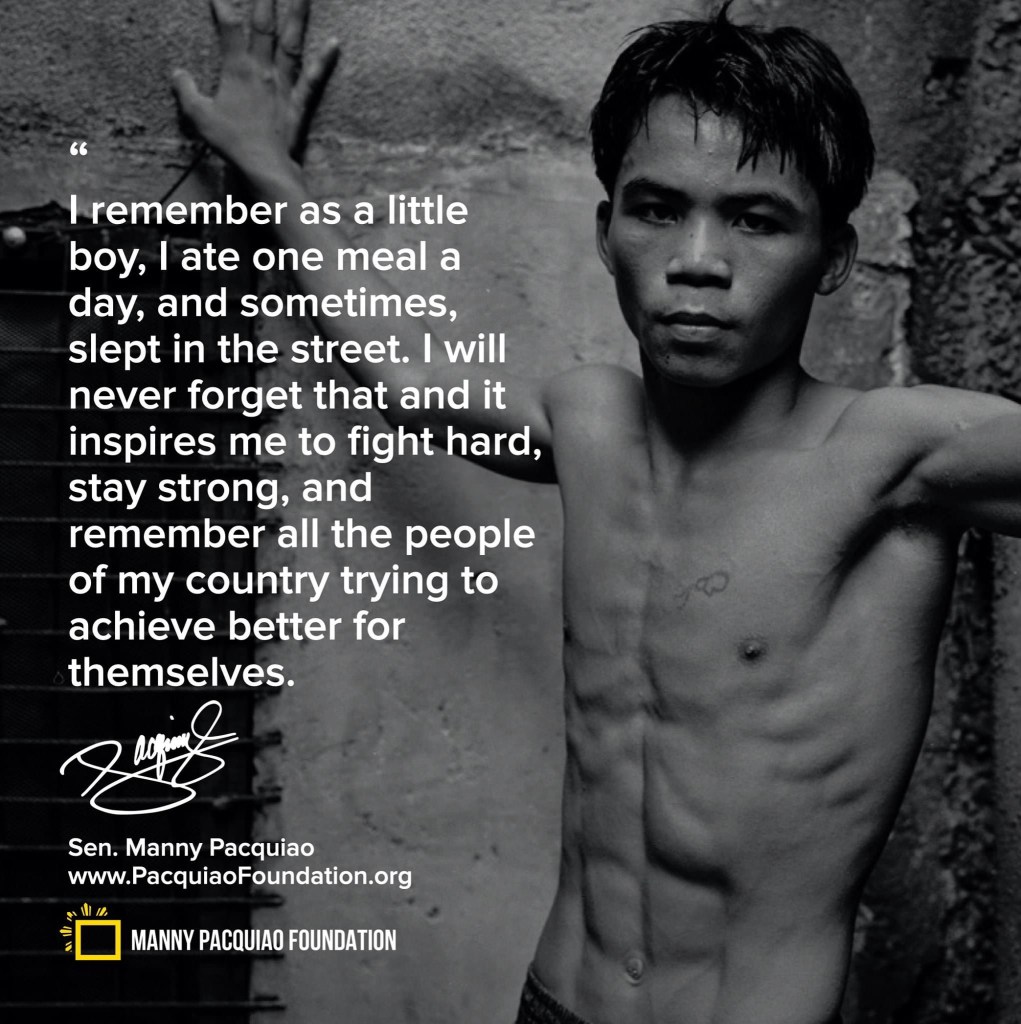
From Manny Pacquiao Facebook Page
If they say that poverty is the reason why poor people tend to think short-term, then they are in a dead loop. Because short-term thinking is what causes poverty. The mindset that causes people to permanently live in the now.
It is understandable that when a person is preoccupied with thinking about what to eat for the following day, it will be hard to think of longer term goals. But it doesn’t have to be so in a single night. That kind of mindset is basically the reason why poor people remain poor.
If you tried to save 10% of whatever you have everyday, a small sacrifice for ten days, you’ll have 100% extra on your 11th day. No matter how small things may seem, if you put them together, it won’t seem small anymore.
This isn’t anything new. There are many out there who have successfully pulled themselves out of the pit. You don’t need to strive to be part of the 1%. There’s a reason it’s called the top 1%. You just have to put extra effort, sacrifice a little, change the way you think, and stack it all together. It’s just like getting fit or getting ripped with 6 pack abs. You can’t get that overnight? You’ll have to work it out!
Privilege
Some people might say, it’s easy to say for those who are privileged. But even if someone has the privilege, if he doesn’t know how to maximize that advantage, he’d most likely end up losing it all and fall down to the very same pit where poor people are trying so hard to escape.
And you can’t make that as an excuse. Someone’s advantage is someone else’s disadvantage. Same as someone’s strength is another’s weakness. If you compare it like that, then you’ve justified that you’re hopeless — not because you are poor, but because your mindset has cursed you to rot in that very pit you’re trying to brave.
Conclusion
So yes, I still blame it on the mindset, not the person. But the person must learn to change his way of thinking; or else, he’ll be doomed in that pit forever.
I know you know what deja vu is — or maybe not. But this is a different kind of deja vu. It’s only related to watching movies – weird. Often times, right after watching a new movie, something I know I’ve never watched prior to watching it, I get the sense that it isn’t new and that I’ve watched it before in a different occasion.
It’s deja vu! I’d normally say, “this movie feels so familiar…”. But the truth is, it’s obviously familiar because I just finished watching it. The problem is, I feel like I’ve watched it at an older time, like the movie isn’t anything new. I couldn’t clearly explain it, because I couldn’t tell the exact time when I’ve previously watched it. I just know. I just feel.
What worries me is that I haven’t experienced it just once. In almost every occasion that I get to watch a new and really good movie, or series, I get this deja vu feeling like it’s something I’ve already seen in the past. It feels too familiar.
So is it some kind of a mental disease or disorder? I don’t really know the answer. I’ve searched for this so many times on the internet and I have only come across 1 related comment from a certain online forum. And the experience isn’t even first hand. She was telling a story about her mom or grandmother who experiences about closely the same experience I get every time after watching new movies. Creepy.
If you know what this is or have an idea what I’ve been experiencing, please let me know in the comments.
I think that as early as when she was 2, she has already pre-determined gender colors based on her feeding bottles. Can’t blame her, she’s been seeing all pink since she was born. (blame it on the mother — shhh!)
By the time our little boy was already 1 year old, our daughter has been very picky with colors — from feeding bottles to whatever. “I like pink!”, “That’s not for me”, “that’s mine!”, these are some of the lines she says whenever there’s a gift, a new item, a toy, or what not, and her possessive statements are often based on colors.
For some reason, she understands that pink and yellow is for her, blue and green is for his baby brother, and white is a neutral color so it can be for either her or her brother. Hmmm… that got me thinking.
Because on the contrary, although I think our boy understands which feeding bottles are for him, he doesn’t really care much which color we give him. We know he gets to identify which is his and which is for her sister because he would shout, “mine!” or “ate!”, to let us know that he got to identify if the bottle is his or her ate’s. But when it comes to using them, he doesn’t care what color or who owns them. As long as it has milk, he’ll drink it.
On the other hand. “Ate” is a bit too picky. If we try to give her a blue or green bottle, she’ll cry and say, “it’s not mine”. Sometimes I say, “Sorry baby, let’s borrow first from your brother, OK? We ran out of clean bottles already…” Then she’ll frown really hard and shout, “NO!”
OK! That’s it! It’s time to wash the feeding bottles 😦
But why is Tweety Bird a girl icon?
I’m sorry, but I’m really unsure how Tweety Bird became famously attributed to girly products. And now it’s on my daughter’s feeding bottle. But newsflash everyone! If you didn’t know yet, Tweety Bird is a male character. The color maybe yellow and his lashes maybe girly long, but hey! Tweety is not a girl!
I just knew it! I’ve been wondering about it, too, for quite some time now. I know he sounded like a male character back when I was a kid. So I had to Google this thing to confirm it.
Nonetheless, my daughter already got used to the sight of this character as an identifier for girl products. Whenever she sees it’s Tweety, she knows it’s for her. Good job marketing! You’ve just started teaching kids about gender stereotypes.
Gender Stereotype
I’m just kidding. Although these companies produce items with color and images of cartoon characters, the stereotype isn’t taught by the manufacturer or the product itself. It is obviously us parents who feed gender stereotypes into our kids’ developing brains.
When you go shopping for baby items, you immediately know which ones are for girls or for boys. This is regardless of the labels, the section, or what the sales persons tells you. Why? Because as grown-ups, we have our own preferences. The gender stereotype is decided by us parents, not the kids, not the companies.
When we bought pink and yellow items for our baby girl, she identified it soon enough that the colors are attributed to her. But if we had chosen different colors from the start, would she have known that it should not be for her? No. She doesn’t know that. She just adopted our preferences.
But I’m still wondering how she understands that white is a neutral color.





 In My Opinion